ATmega328P-AU KiCad symbol and footprint
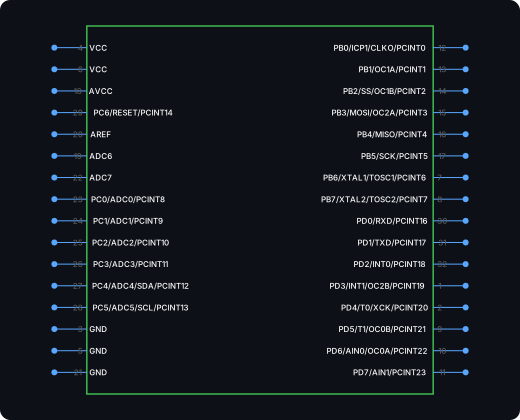
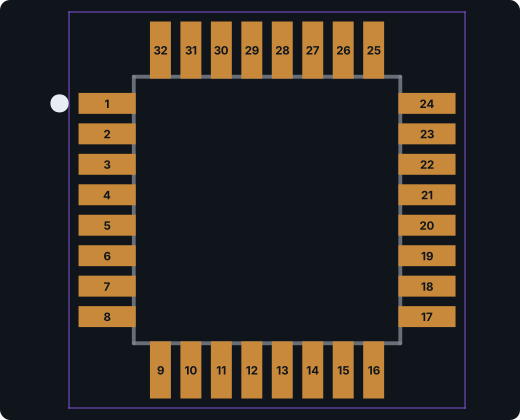
8-bit AVR microcontroller, the chip on the Arduino Uno, in a 32-lead TQFP. PartSpark generated this schematic symbol and TQFP-32 PCB footprint from the part number alone. We then checked every pin and pad against the Microchip Technology datasheet.
TQFP-32, 7 × 7 mm, 0.8 mm pitch · 32 pins · 32 pads · footprint TQFP-32_7x7mm_P0.8mm · generated 2026-10-01
What we checked
Checked against the datasheet
Source: Microchip DS40001984A, Figure 5-3 (32-pin TQFP top view, page 16). Checked 2026-10-01.
- All 32 pin numbers and names match Figure 5-3, the 32-pin TQFP top view on page 16 of Microchip DS40001984A, counter-clockwise from PD3 at pin 1.
- Power pins are complete: VCC on 4 and 6, AVCC on 18, GND on 3, 5, and 21. The TQFP has no exposed pad.
- The datasheet has no recommended land pattern, so the footprint uses standard TQFP pads: 1.50 × 0.55 mm at 0.8 mm pitch, rows 8.40 mm apart. KiCad’s own TQFP-32 footprint uses 1.475 × 0.55 mm pads 8.325 mm apart. Compare against your fab rules before release.
To use the files, add the .kicad_sym under Preferences → Manage Symbol Libraries and put the .kicad_mod in a .pretty folder registered under Manage Footprint Libraries with the nickname ProtoFlow.pretty, which is what the symbol’s Footprint field points to. Review the land pattern against your fab’s rules before ordering boards.
Pin map
ATmega328P-AU pinout
| Pin | Name | Electrical type |
|---|---|---|
| 1 | PD3/INT1/OC2B/PCINT19 | Bidirectional |
| 2 | PD4/T0/XCK/PCINT20 | Bidirectional |
| 3 | GND | Power input |
| 4 | VCC | Power input |
| 5 | GND | Power input |
| 6 | VCC | Power input |
| 7 | PB6/XTAL1/TOSC1/PCINT6 | Bidirectional |
| 8 | PB7/XTAL2/TOSC2/PCINT7 | Bidirectional |
| 9 | PD5/T1/OC0B/PCINT21 | Bidirectional |
| 10 | PD6/AIN0/OC0A/PCINT22 | Bidirectional |
| 11 | PD7/AIN1/PCINT23 | Bidirectional |
| 12 | PB0/ICP1/CLKO/PCINT0 | Bidirectional |
| 13 | PB1/OC1A/PCINT1 | Bidirectional |
| 14 | PB2/SS/OC1B/PCINT2 | Bidirectional |
| 15 | PB3/MOSI/OC2A/PCINT3 | Bidirectional |
| 16 | PB4/MISO/PCINT4 | Bidirectional |
| 17 | PB5/SCK/PCINT5 | Bidirectional |
| 18 | AVCC | Power input |
| 19 | ADC6 | Input |
| 20 | AREF | Passive |
| 21 | GND | Power input |
| 22 | ADC7 | Input |
| 23 | PC0/ADC0/PCINT8 | Bidirectional |
| 24 | PC1/ADC1/PCINT9 | Bidirectional |
| 25 | PC2/ADC2/PCINT10 | Bidirectional |
| 26 | PC3/ADC3/PCINT11 | Bidirectional |
| 27 | PC4/ADC4/SDA/PCINT12 | Bidirectional |
| 28 | PC5/ADC5/SCL/PCINT13 | Bidirectional |
| 29 | PC6/RESET/PCINT14 | Bidirectional |
| 30 | PD0/RXD/PCINT16 | Bidirectional |
| 31 | PD1/TXD/PCINT17 | Bidirectional |
| 32 | PD2/INT0/PCINT18 | Bidirectional |
Need a part that isn’t here?
The same generator works for any part with a datasheet. Use the KiCad symbol generator, the KiCad footprint generator, or convert a datasheet to a schematic symbol.
More examples: B2B-PH-K-S KiCad symbol and footprint · TPS62160DSG KiCad symbol and footprint · AMS1117-3.3 KiCad symbol and footprint